
Home / Costs and shipping
What you pay an agent, from the seller's tag to the box on your step
The lines that make up the bill, how an agent turns yuan into your currency, and how weight and size set the freight. No Vivabuy figures, because there is no Vivabuy agent to charge them.
Seven charges between checkout and customs
An agent order is paid in two or more goes, and the lines arrive at different times. Here is the full stack, with when each line is paid and where to look it up on your agent's site. Your agent may group or name the lines differently, but each one turns up somewhere.
| Line | What it is | When you pay it | Where to check it |
|---|---|---|---|
| Item price | What the seller lists, in yuan, for your variant | Paid when you order | The listing, and the order page at your agent |
| Delivery inside China | The seller's charge to send the item to the agent's warehouse, set by the seller and sometimes zero | Paid when you order | The listing, shown again at checkout |
| Agent service fee | A percentage or flat charge on purchases; several agents advertise none | Paid when you order | The agent's fee page |
| Payment charge | A fee or conversion margin added by the card, PayPal or wallet you pay with | Each time you pay or top up | The payment step at checkout |
| Extras | Extra photos, measurements, better packing, a pre-pack weight quote | When you choose them | The value-added services list |
| International freight | Set by the line you pick, the packed weight or size, and the destination | When you send the parcel | The shipping estimate tool |
| Taxes at the border | Duty, sales tax or VAT and handling, under your own country's rules | On import | Your country's customs or postal service |
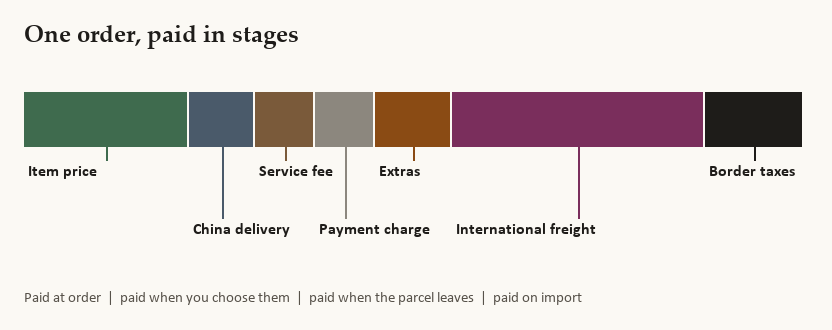
The first three lines are what most "price" talk is about, and on a light order they can be the smaller part. For a single light T-shirt, the freight can come close to the price of the shirt, and bulky items widen the gap. That is why people collect several items in the warehouse and ship them together.
Exchange rates: what your agent shows against the market
Sellers price in yuan. Your agent shows you prices in dollars or another currency using an exchange rate it sets, and that rate usually sits a little above the mid-market rate, the midpoint between buying and selling rates that currency sites quote. The gap is part of what you pay, even at an agent that advertises no service fee.
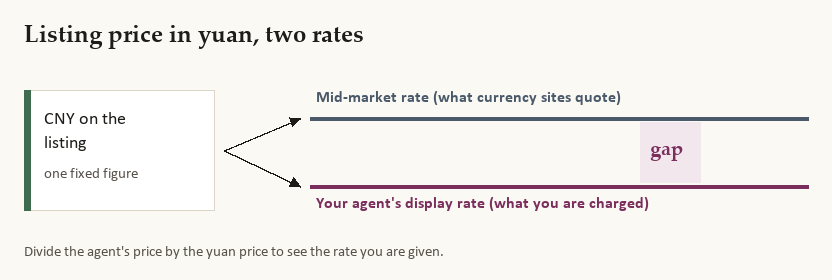
To check it, look at one listing in yuan, note the dollar figure your agent shows for it, and divide. Compare the result with a mid-market rate from the same hour. Do this once at each agent you consider; the gap tends to stay put from day to day while both rates drift. Your card or PayPal may then add its own conversion charge on top, which is a separate line on the bill.
How international shipping is priced
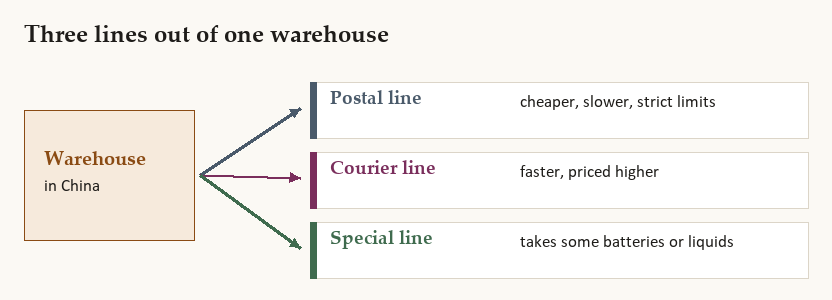
An agent does not ship things itself. It sells space on shipping lines run with carriers: postal services, couriers and consolidated lines to particular countries. Each line has its own price table, delivery window and list of goods it will take. Some lines refuse batteries; others take liquids such as perfume; some stop at a weight limit.
The price is set by weight and destination, and the weight is whichever is greater: the parcel's actual weight, or its volumetric weight worked out from its size. LoongBuy's estimation page spells out that greater-value rule, and so do most agents' pages. The real figure is known only after packing, so the estimate you see when you order is just that.
Two agents offer a packed-weight quote before you commit: Sugargoo charges CNY 18 per parcel for rehearsal packaging, and LoongBuy CNY 20, which it deducts from the freight if you go ahead (both read from their help pages; see Picking an agent). For a large or mixed parcel, a quote like that can save more than it costs.
Volumetric weight with plain numbers
Volumetric weight turns a box's size into kilograms: multiply the three sides in centimeters, then divided by a number the line sets. Lines publish their own divisor, so look it up on the line description. As an example only, if a line used 6,000, a 40 by 30 by 20 cm box would count as 4 kg however light it was inside.
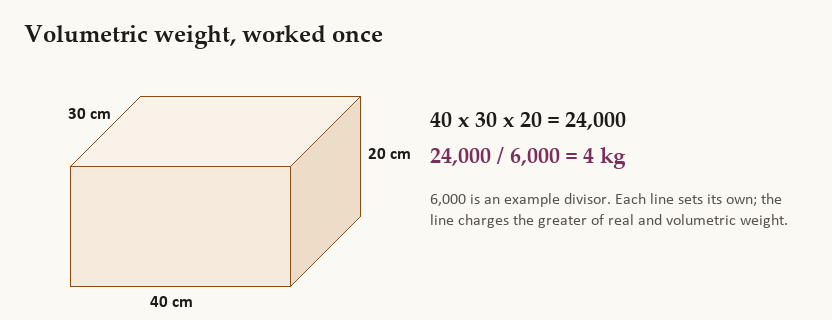
Shoe boxes, puffer jackets and anything with a rigid case are the usual surprises. Asking the warehouse to remove shoe boxes or vacuum-pack soft clothing, where the agent offers it, can bring the volumetric weight down. Ask before you pay for the parcel, not after.
Duties and customs at your end
Whatever arrives in your country goes through its customs rules, and the agent cannot waive them. Each country sets its own thresholds, rates and handling charges, and some collect tax before delivery while others bill you at the door. Check your own customs or postal service's page for imports before you send a large parcel.
One firm rule from us: describe the contents of a parcel truthfully. The agent will ask you to fill in a declaration; what goes on it is your responsibility, and we do not give advice on what to put there.

Free storage runs from a status, not a date
Free storage gives you time to collect items into one parcel, and every agent counts it from a status, not from the day you ordered. Among the five agents on our list it ran from 90 to 100 days for items, as read in October and November 2026. After that, agents charge per day or treat the goods as abandoned.
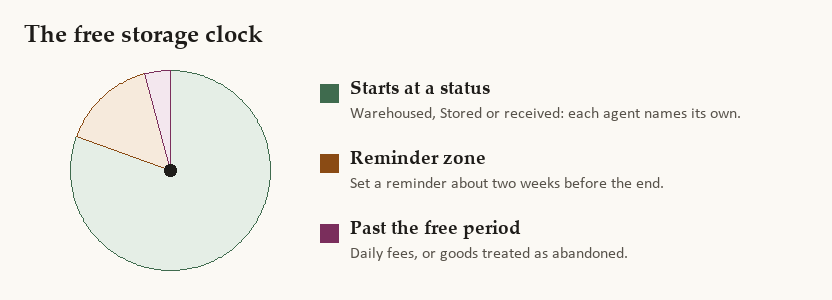
Set a reminder for two weeks before the end of the free period. Items that arrive late in that window may be worth sending in a second parcel rather than holding everything back.