Home / Storefront sorter
Storefront sorter: eight visible traits, five kinds of site, and the misfits greyed out
Eight traits, five kinds of site. You never type an address and the sorter never grades anyone; it narrows down what kind of storefront your answers describe.
Answer the eight traits
Answers you are not sure about are better left on Can't tell. A wrong Yes rules out kinds that might be right; a Can't tell only means the sorter has less to work with.
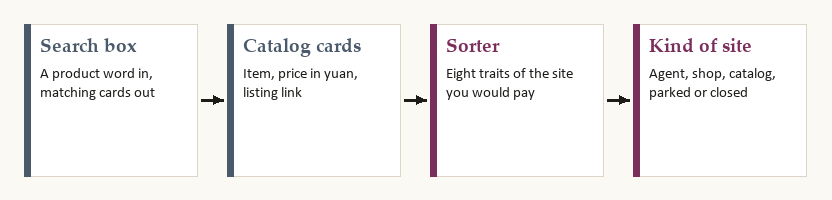
Search finds items; the sorter checks sites
The two tools on this site do different jobs, so here is how to use the search and the sorter side by side. The product search, which sits under the headline on the home page and the catalog, finds listings: type a plain product word, such as "corduroy jacket" or "fleece vest", and you get matching listings from the catalog with their yuan prices. Short, concrete English words work best. The search refuses an empty box, including one with only spaces in it.
The sorter checks the other half of the purchase: the site you are about to pay. Use it when you meet a shopping site through a video, a comment or a brand-like name, before you create an account or send money. Keep the site open in another window, look for each trait on its pages, and answer here. Most sites sort out in three or four answers.
Why each trait rules out what it does
The expected answers are public so you can disagree with them. Here is the reasoning for each trait, and the one extra rule for shops.
| Trait | What you look for | Why it separates the kinds |
|---|---|---|
| Trait 1 | The site takes a Taobao, Weidian or 1688 product link (or searches those marketplaces itself) and lets you order that item. | Only a buying agent turns a marketplace listing into an order. A shop sells its own items, a catalog sends you elsewhere, and a parked or closed page sells nothing. |
| Trait 2 | Goods from different Chinese sellers wait together in one warehouse in China until you ask for them to be packed as one parcel. | Holding goods from several sellers is the agent's warehouse job. A shop ships from its own stock and never holds your marketplace orders. |
| Trait 3 | International shipping is priced after the goods reach that warehouse, by weight and destination. | An agent can only weigh what has arrived. Shops usually quote delivery up front or include it; the other three kinds ship nothing. |
| Trait 4 | Products are sold at the site's own fixed prices, with an add-to-cart button. | Some agents run a small in-house shelf beside the marketplace search, so a cart alone does not separate an agent from a shop. A catalog, a parked page and a closed page have no cart. |
| Trait 5 | The only way to order is to message someone in a chat app. | An agent takes orders and payment inside its own logged-in website. Some shops sell through chat apps only. The other kinds take no orders at all. |
| Trait 6 | The buy button takes you away to a different website. | Sending you elsewhere is what a catalog does with every item. Ad links on a parked page may also lead away, so this row cannot rule a parked page in or out. |
| Trait 7 | The page offers the domain itself for sale, or shows only ads and related-search links. | That is the whole content of a parked or for-sale name. No trading site looks like this. |
| Trait 8 | The page says the store is unavailable or closed. | A closed store says so. Every other kind is either trading or never was a store. |
The shop rule. A shop has to sell somehow: through a cart, through a chat app, or both. If you answered No to both, it is not a shop.
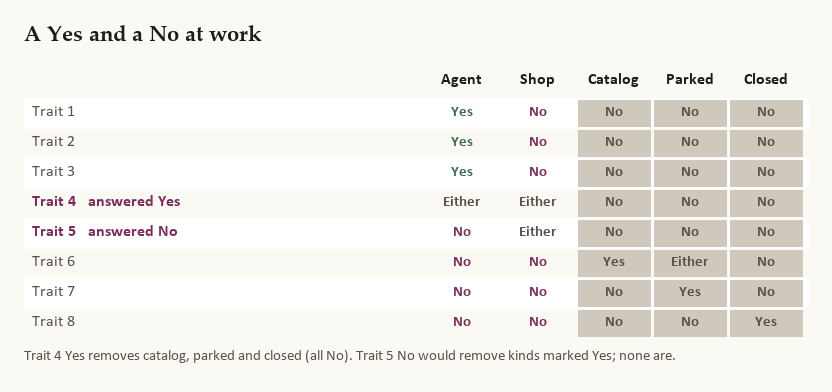
If you think an expected answer is wrong for a site you have seen, write to us with the trait number and what the site showed. The table was last checked on November 10, 2026.
Three sites sorted, with no names attached
These are composites, put together from the kinds of page we saw while checking the Vivabuy name. No real site is described.
A cart, euro prices and a chat button
The site has product pages with prices in euros and an add-to-cart button (trait 4: Yes). There is no box for a marketplace link and no mention of a warehouse (trait 1: No, trait 2: No). That leaves one kind: an own-stock shop. Whatever it sells, it cannot buy a Weidian listing for you.
A page of related searches
The address shows a list of ad links titled with the domain name and nothing else (trait 7: Yes). One answer already rules out four kinds, but the sorter asks for a second; trait 8 (No, there is no closed-store notice) confirms a parked name.
A paste box and a warehouse in Guangdong
The home page has a search bar that accepts Taobao and 1688 links (trait 1: Yes), and the help pages describe free storage in a warehouse in China and parcels priced after weighing (traits 2 and 3: Yes). That is a buying agent. The next stop is the page list on Picking an agent.

Limits of a kind-only answer
The sorter tells you the kind of storefront, not its quality. A buying agent can still be slow, expensive or badly organized; a shop can be honest and pleasant to deal with. Judging an agent is a separate step with its own checklist.
It also does not look anything up. It does not fetch the site, read its domain records or compare it with a list. There is no score and no green or red light, only the kinds your answers leave standing. That keeps it useful for any site, including ones that appear after we last checked the Vivabuy name.